

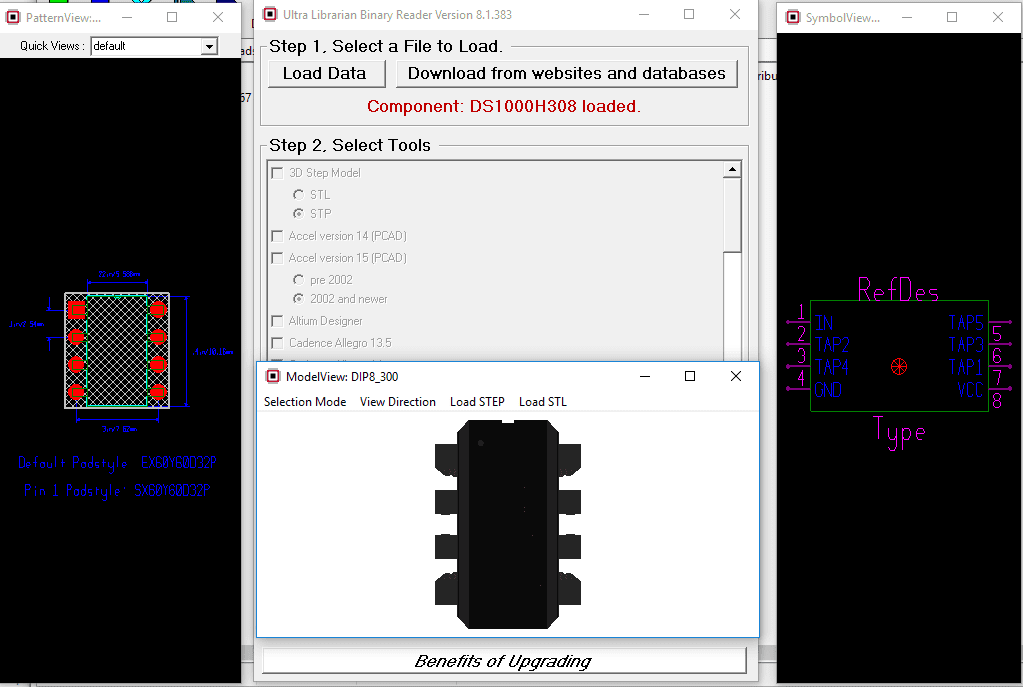
CREATE SYMBOLS, FOOTPRINTS, AND 3D MODELS FROM PRE-AUTHORED DATA

ULTRA LIBRARIAN FREE READER

Preview models prior to downloading

Choose from over 20 different CAD export options

aagmaal series latest install
CONVERT BXL FILES INTO YOUR PREFERRED CAD FORMAT

The free reader is a lite version of Ultra Librarian specifically designed to import vendor neutral CAD data (.bxl files) from manufacturers’ websites and then export symbols, footprints, and 3D models to specific CAD tool formats. The reader is a read-only tool and will not allow users to make any changes to the data. For symbols, footprints, and 3D model creation capabilities, use one of the Ultra Librarian Desktop Software options.

BXL FILES FROM YOUR FAVORITE IC MANUFACTURERS

Many of our IC partners offer BXL files for their components directly on their websites. Once you have obtained a BXL file it is quick and easy to convert to your preferred CAD format through our online BXL conversion tool.

Check out all manufacturers here.

EXPORT TO OVER 30 DIFFERENT CAD FORMATS

VENDOR NEUTRAL FILES

Accel EDA 14 & 15

  • DesignSpark
  • Mentor Graphics
  • BoardStation
  • Mentor Graphics Design Architect
  • Mentor Graphics Design
  • Expedition 99 and 2000
  • PCAD 2000, 2001, 2002, 2004, and 2006
  • STL
  • TARGET 3001!
  • View Logic ViewDraw
  • Zuken CadStar 3 and 4
  • Zuken CR-5000 and CR-8000

FREQUENTLY ASKED QUESTIONS

A .BXL file contains electronic data created by Ultra Librarian in a universal format and is used for distributing PCB information. .BXL files can be opened by the Ultra Librarian Free Reader and translated into your choice of 22 different CAD formats.

Ultra Librarian has partnered with major IC manufacturers to create electronic data representing their parts and are available to the public. Partners include Analog Devices, Texas Instruments, Microchip, Maxim, Silicon Labs, Renesas, Exar, and NXP.

Yes, you can use our Online Reader if you don’t want to download the Free Reader

Free Reader

"*" indicates required fields

Emotionally, the piece is subtle but resonant. It avoids didactic statements, trusting viewers to synthesize. The result is a contemplative ache: recognition without complete resolution. That open-endedness is its strength, inviting repeated visits rather than a single, conclusive interpretation.

The centerpiece is ritual as language. Rather than treating rites as static relics, the install presents them as verbs: enacted, modified, and translated across generations. Objects and gestures become vocabulary—candles that mark memory, repeated movements that map grief and joy—so that viewers read meaning in cadence and repetition rather than exposition.

In short, the latest "Aagmaal" install is an elegant meditation on practice and presence. It reframes ritual as living grammar, delivered with minimalism that amplifies intimacy—an invitation to witness how small acts stitch individual lives into larger patterns.

Thematically, the install interrogates continuity: what we inherit, what we shed, and what we reinvent. It avoids nostalgia; instead, it stages a negotiation between lineage and autonomy. Characters—if they can be called that—navigate prescribed forms while asserting personal inflection, suggesting that ritual survives through adaptation rather than pure preservation.

Formally, the piece is spare but exacting. Sparse lighting and a quiet soundscape pull attention to small, deliberate actions; a slowed rhythm makes ordinary motions feel monumental. The pacing asks the audience to lean in, to discover significance in the spaces between beats. Visual austerity is offset by tactile detail—fabric, breath, the scrape of a hand—so the experience registers physically as well as intellectually.

"Aagmaal" fuses the intimate pulse of ritual with contemporary storytelling, and its latest install deepens that dialogue. This new episode reframes familiar motifs—devotion, time, and the human body—by folding them into a compact, sensory-rich narrative that feels both ancient and urgently modern.


the pcb design, assembly, and trends blog

RELATED CONTENT

Aagmaal Series Latest Install Online

Emotionally, the piece is subtle but resonant. It avoids didactic statements, trusting viewers to synthesize. The result is a contemplative ache: recognition without complete resolution. That open-endedness is its strength, inviting repeated visits rather than a single, conclusive interpretation.

The centerpiece is ritual as language. Rather than treating rites as static relics, the install presents them as verbs: enacted, modified, and translated across generations. Objects and gestures become vocabulary—candles that mark memory, repeated movements that map grief and joy—so that viewers read meaning in cadence and repetition rather than exposition. aagmaal series latest install

In short, the latest "Aagmaal" install is an elegant meditation on practice and presence. It reframes ritual as living grammar, delivered with minimalism that amplifies intimacy—an invitation to witness how small acts stitch individual lives into larger patterns. Emotionally, the piece is subtle but resonant

Thematically, the install interrogates continuity: what we inherit, what we shed, and what we reinvent. It avoids nostalgia; instead, it stages a negotiation between lineage and autonomy. Characters—if they can be called that—navigate prescribed forms while asserting personal inflection, suggesting that ritual survives through adaptation rather than pure preservation. what we shed

Formally, the piece is spare but exacting. Sparse lighting and a quiet soundscape pull attention to small, deliberate actions; a slowed rhythm makes ordinary motions feel monumental. The pacing asks the audience to lean in, to discover significance in the spaces between beats. Visual austerity is offset by tactile detail—fabric, breath, the scrape of a hand—so the experience registers physically as well as intellectually.

"Aagmaal" fuses the intimate pulse of ritual with contemporary storytelling, and its latest install deepens that dialogue. This new episode reframes familiar motifs—devotion, time, and the human body—by folding them into a compact, sensory-rich narrative that feels both ancient and urgently modern.