Example: The film’s climactic reconciliation scenes emphasize dialogue and intimacy over spectacle, signaling a tonal shift from scenes meant to titillate to scenes meant to humanize. Parallel to theatrical release is the pirated afterlife on sites like Filmyzilla: a shadow distribution network that mirrors demand in real time. Filmyzilla typifies a category of websites that upload films without authorization, offering downloads or streams that circumvent paywalls and release windows. This creates a parallel audience that consumes the film outside box-office and subscription metrics.

— End of Chronicle —

Note: This chronicle examines the cultural phenomenon and online circulation surrounding “Fifty Shades of Grey 3” (the third film in the Fifty Shades trilogy) and the parallel ecosystem of unauthorized streaming and piracy sites like Filmyzilla. It is structured into themed sections with vivid detail and examples to make the issues and effects clear. 1. Prologue — The Franchise and Its Finale Fifty Shades began as a runaway romance-turned-pop-cultural lightning rod: a best-selling novel series that translated into glossy studio films mixing erotic melodrama, star power, and mainstream curiosity. The third film—released as the trilogy’s conclusion—arrived carrying both fan expectations and critical skepticism: a finale meant to tidy character arcs, intensify emotional stakes, and deliver the franchise’s characteristic blend of romance and erotica.

Example: Fans tuned in for closure between Ana and Christian; critics watched for how the franchise would evolve its visual language after two films of similar tone. Finale films often amplify desire: final reconciliations, heightened conflict, and the promise of catharsis. The third installment used these narrative mechanics—reparation, forgiveness, and domestic stability—to pivot from pure erotic spectacle toward an attempt at emotional maturity.

Example: A rare subtitled camrip circulating on niche forums may be the only available record of how local censorship altered dialogue for a given region. The legacy of Fifty Shades of Grey 3 is threefold: narrative closure for a mainstream erotic melodrama; a case study in how modern piracy ecosystems intersect with franchise culture; and a reminder of the messy afterlife films lead once released into a global, digitally networked public.

Example: A short clip of a tense exchange circulates on social feeds, generating parody edits that diverge from the film’s intended tone and propagate secondary fan engagement. Some users turn to piracy for accessibility reasons—lack of regional release, prohibitive cost, or platform unavailability—raising questions about equitable access. Others exploit piracy to avoid paying for content. Any analysis must acknowledge both drivers without excusing illegality.

Concluding vignette: a fan in a region without legal access watches a compressed copy on a small screen, sharing a clip that spawns a meme; a studio files a takedown; critics continue to debate artistic merit—each actor in this ecosystem shaping, in small ways, the film’s cultural footprint.

Example: Within days of the film’s home-premiere window, pirated copies appear in multiple resolutions—480p, 720p, 1080p—often with inconsistent audio mixes or watermarks, reflecting a chaotic, crowd-sourced distribution ecosystem. Piracy changes economics and culture simultaneously. For viewers, it lowers the cost of access and dissolves artificial release boundaries; for rights-holders, it dilutes revenue and complicates distribution strategy. For a franchise like Fifty Shades—already built on mass-market appeal—the immediate availability on piracy sites can both broaden viewership and erode measured success.

Example: Studios issue DMCA notices; anti-piracy coalitions release reports quantifying alleged revenue loss associated with piracy, though causality and measurement often remain contested. Online communities transmute film moments into memes, GIFs, and reaction videos. Pirated clips accelerate that process—short, shareable fragments spread widely, sometimes eclipsing official marketing. For Fifty Shades’ third chapter, certain lines or visual motifs become shorthand across platforms.

Example: A leaked cam version may briefly spike online conversation and meme cycles, but box-office figures and legitimate streaming deals may take measurable hits in regions where pirated copies proliferate. Pirated copies come in many “versions”: camrips (shot in theatres), telesync, HDTV rips, WEB-DL, and encodes with variable compression. Each version affects viewers’ experience—grainy visuals, chopped frames, out-of-sync audio—altering perception of the film’s craft. Ironically, inferior copies can also spawn cult attention through bootleg novelty.

Example: Regions without a timely local release see higher rates of unauthorized downloads; conversely, markets with affordable legal streaming show lower piracy incidence. Bootleg copies sometimes become unintended archives, preserving versions otherwise lost. While ethically fraught, these artifacts can later serve researchers studying reception, censorship, or distribution history.

Example: An early camrip of the third film may present muffled dialogue in key emotional moments, leading to misinterpretation or mockery on social platforms; later WEB-DL versions restore clarity and shift discourse. Unauthorized distribution provokes legal responses—takedown notices, ISP blocking in some jurisdictions, and protracted anti-piracy campaigns. Ethically, the debate balances individual access against creators’ rights and livelihoods. Franchise films, backed by major studios, are frequent target of enforcement, while the porous, international nature of piracy complicates deterrence.
For Windows 11
and Windows 10
For iPhone 17, 16, 15, 14 and Max, iPad Pro
and iPhone 13, 12, 11, XR, iPhone X, SE, iPad

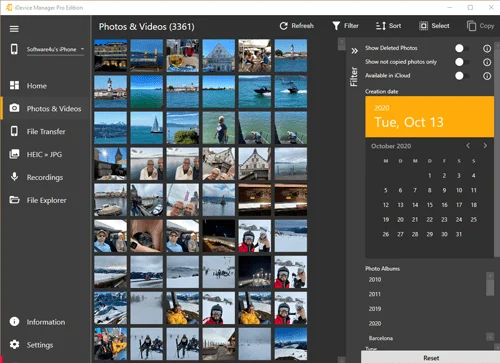
📶 Copy iPhone photos and videos via Wi-Fi – wirelessly & lightning fast


With iDevice Manager, you can transfer your iPhone photos and videos wirelessly to your PC via Wi-Fi – without any cables or iTunes. Simply connect your iPhone to the same Wi-Fi network as your computer, and you can conveniently browse, select, and save all your media files.

Advantages:

👉 Benefit: Back up your photos wirelessly, flexibly, and effortlessly – just connect, select, and save.

📸 Copy iPhone photos to PC – free up storage space with just one click


With iDevice Manager, you can save iPhone photos to your PC, organize them, and back them up – without iTunes or iCloud. Whether it's vacation photos, screenshots, or videos, you can transfer your files directly to your computer without any loss of quality.

Special advantages:
  • Transfer multiple photos or entire albums at once
  • Automatic detection of new images
  • No loss of quality or compression
  • Secure backups of your memories with one click

👉 Tip: Save storage space on your iPhone – back up your favorite images permanently on your PC!


Transfer iPhone photos & videos to PC – easily, quickly, and without iTunes (Windows 10/11)

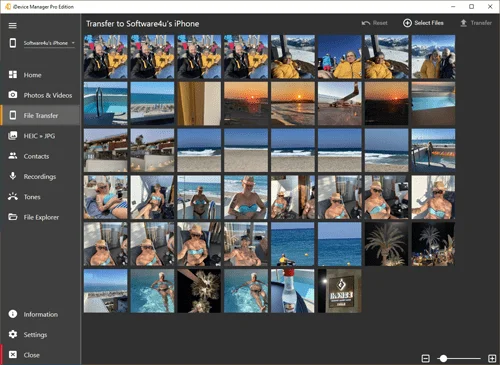
📤 Copy photos and videos to iPhone – manage media freely


With iDevice Manager, you can not only copy data from iPhone to PC, but also transfer photos and videos from PC back to iPhone – without iTunes or the cloud.

Advantages:
  • Manually add photos, videos, and music files
  • Create your own albums or playlists
  • No Apple restrictions
  • Supports JPG, MP4, HEVC, HEIC, and more

👉 Benefit: Transfer your favorite photos and videos directly from your PC to your iPhone – media management has never been easier!


Transfer photos and videos from your PC to your iPhone – easily and securely

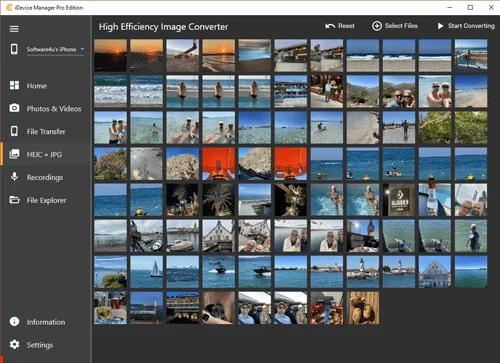
🧩 Convert HEIC to JPG – Make photos compatible


HEIC files are the standard format for iPhone images – but they are not always compatible with Windows or older programs. With the integrated HEIC converter, you can easily convert your photos to JPG or PNG.

Advantages:
  • Batch processing of multiple files at once
  • No loss of quality
  • High compatibility with all image editing programs
  • Fast export to your PC

👉 Tip: Make your iPhone images compatible – convert them to JPG format with just one click.


Convert HEIC to JPG – Make iPhone photos compatible

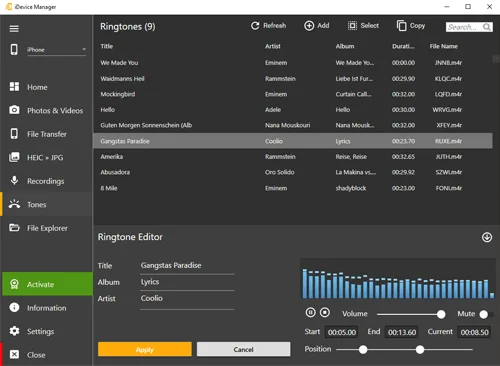
🎵 Manage ringtones – your own iTunes alternative


Create your own music library, transfer songs to your iPhone, or export them to your PC. iDevice Manager completely replaces iTunes and allows you to freely manage MP3 files, ringtones, and playlists.

Features & Benefits:
  • Import ringtone files directly to your iPhone
  • Create custom ringtones in seconds
  • Sync without iTunes restrictions
  • Listen to your ringtones with the built-in player

👉 Benefit: Listen to what you want, when and where you want, without any Apple restrictions.


Manage iPhone ringtones – iTunes alternative for Windows

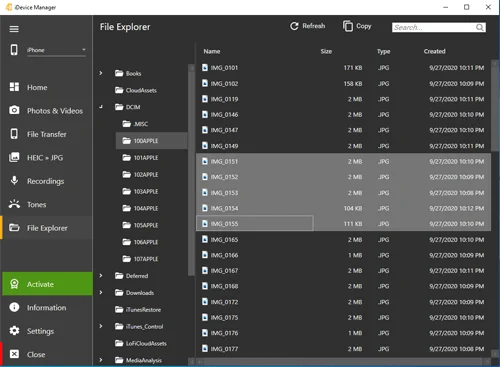
🗂️ File Explorer – Access all iPhone files


The integrated File Explorer in iDevice Manager allows you to download or access any files from your iPhone, even if Apple normally blocks access. You can browse and copy documents, app data, system files, or media files—giving you full control over your device.

Features & Benefits:
  • Direct access to iPhone directory structure
  • Copy, delete, or back up files and folders
  • Support for freely accessible app data
  • No jailbreaks or Apple access rights required

👉 Tip: Use your iPhone like a USB stick – discover and back up all files without restrictions.


iPhone File Explorer – Access all iPhone data & app files

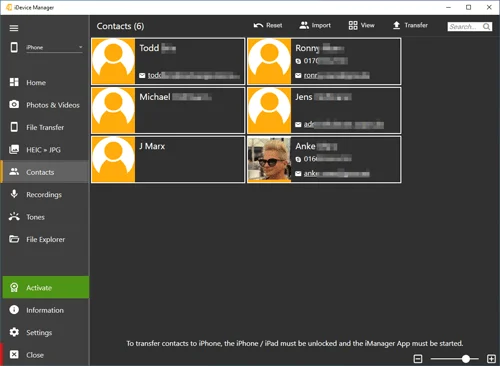
📇 Synchronize Outlook contacts with iPhone – simple and reliable

Keep your contacts up to date everywhere! With iDevice Manager, you can synchronize Outlook contacts (Outlook classic) directly with your iPhone – in both directions. Ideal for business and private users who want to update their contacts regularly.

Advantages:
  • Direct synchronization between Outlook classic and iPhone
  • Synchronization of names, phone numbers, email, and notes
  • No iCloud or iTunes login required
  • Supports Outlook 2016, 2019, 2021, 2024 and Microsoft 365

👉 Benefit: Keep your Outlook and iPhone contacts always in sync – without any detours or cloud constraints.


Synchronize Outlook contacts with iPhone – without iCloud or Exchange

Synchronize Windows 10/11 contacts with iPhone

Even without Outlook, you can synchronize your Windows contacts from the Windows Contacts app (People) directly with your iPhone. iDevice Manager automatically recognizes your user profile and syncs names, phone numbers, and addresses with your iPhone.

Advantages:
  • Syncs Windows address book with iPhone
  • Compatible with Windows 10 & Windows 11
  • No additional account or cloud service required
  • Automatic updates when changes are made

👉 Benefit: Your Windows contacts are always with you – up to date, secure, and independent of iCloud or Exchange.


Sync Windows 10/11 contacts with iPhone – automatically & locally

☁️ Transfer Google contacts to iPhone – with just one click


Do you use Gmail or Android and want to transfer your Google contacts to your iPhone? iDevice Manager makes it easy: with just a few clicks, you can import all your Google contacts – including email, phone number, birthday, and notes.

Advantages:
  • Imports directly from your Google account
  • Supports CSV and vCard formats
  • No double data entry required
  • Easy export/import between iPhone & Google

👉 Tip: Switch from Android to iPhone with ease – transfer your contacts securely.


Transfer Google contacts to iPhone – easily import Gmail contacts

📁 Save vCard contacts to iPhone – compatible & fast


Have you saved contacts as .vcf or vCard files? With iDevice Manager, you can import them directly into your iPhone address book. Ideal if you want to transfer contacts from old cell phones, CRM systems, or email applications.

Advantages:
  • Imports vCard files in VCF format
  • Supports multiple imports
  • Retains all contact information (name, email, address, notes, contact photo)
  • Works without iTunes or the cloud

👉 Benefit: Transfer your saved contacts in seconds – from file to iPhone, without any detours.


Import vCard (.vcf) contacts into your iPhone address book – compatible & fast

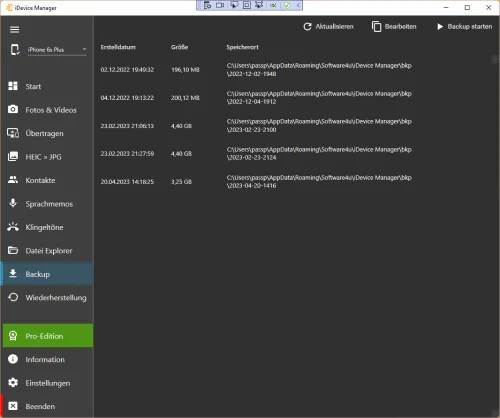
💾 Create an iPhone backup – security for your personal data


With the integrated backup tool, you can reliably back up your data on your PC. Whether photos, contacts, calendars, text messages, or app data – you can save everything manually or automatically.

Advantages of iDevice Backup:
  • Independent of iTunes or iCloud
  • Complete or partial backup of your data
  • Easy to restore with a click of the mouse
  • Data protection through local storage on your PC

👉 Benefit: Protect your memories – create your personal iPhone backup on your computer now.


Back up iPhone to PC – without iTunes & iCloud

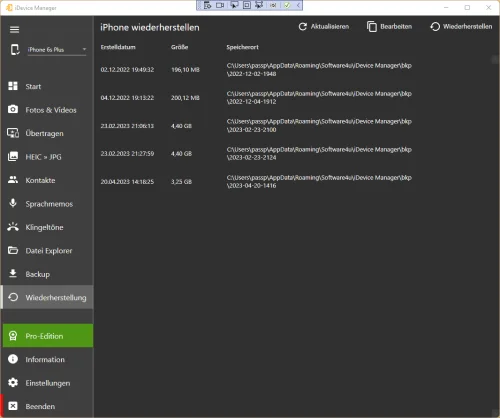
🔄 Restore iPhone without iTunes – Fast, easy & secure


If your iPhone is causing problems or you want to restore data, iDevice Manager is the ideal solution. It allows you to restore backups, select individual files, or completely reset the device – without iTunes.

Advantages:
  • No complicated Apple software required
  • Selective recovery of individual data
  • Time savings thanks to simple operation
  • Secure & compliant with data protection regulations

👉 Benefit: Restore your iPhone – securely, flexibly, and completely independently of iTunes.


Restore iPhone without iTunes – selectively recover data

iDevice Manager Pro-Edition


The license of older iDevice Manager Pro-Edition versions continues to apply to this new program. If you want to upgrade to the iDevice Manager Pro Edition, visit our Shop.

Fifty Shades Of Grey 3 Filmyzilla -

Example: The film’s climactic reconciliation scenes emphasize dialogue and intimacy over spectacle, signaling a tonal shift from scenes meant to titillate to scenes meant to humanize. Parallel to theatrical release is the pirated afterlife on sites like Filmyzilla: a shadow distribution network that mirrors demand in real time. Filmyzilla typifies a category of websites that upload films without authorization, offering downloads or streams that circumvent paywalls and release windows. This creates a parallel audience that consumes the film outside box-office and subscription metrics.

— End of Chronicle —

Note: This chronicle examines the cultural phenomenon and online circulation surrounding “Fifty Shades of Grey 3” (the third film in the Fifty Shades trilogy) and the parallel ecosystem of unauthorized streaming and piracy sites like Filmyzilla. It is structured into themed sections with vivid detail and examples to make the issues and effects clear. 1. Prologue — The Franchise and Its Finale Fifty Shades began as a runaway romance-turned-pop-cultural lightning rod: a best-selling novel series that translated into glossy studio films mixing erotic melodrama, star power, and mainstream curiosity. The third film—released as the trilogy’s conclusion—arrived carrying both fan expectations and critical skepticism: a finale meant to tidy character arcs, intensify emotional stakes, and deliver the franchise’s characteristic blend of romance and erotica.

Example: Fans tuned in for closure between Ana and Christian; critics watched for how the franchise would evolve its visual language after two films of similar tone. Finale films often amplify desire: final reconciliations, heightened conflict, and the promise of catharsis. The third installment used these narrative mechanics—reparation, forgiveness, and domestic stability—to pivot from pure erotic spectacle toward an attempt at emotional maturity. fifty shades of grey 3 filmyzilla

Example: A rare subtitled camrip circulating on niche forums may be the only available record of how local censorship altered dialogue for a given region. The legacy of Fifty Shades of Grey 3 is threefold: narrative closure for a mainstream erotic melodrama; a case study in how modern piracy ecosystems intersect with franchise culture; and a reminder of the messy afterlife films lead once released into a global, digitally networked public.

Example: A short clip of a tense exchange circulates on social feeds, generating parody edits that diverge from the film’s intended tone and propagate secondary fan engagement. Some users turn to piracy for accessibility reasons—lack of regional release, prohibitive cost, or platform unavailability—raising questions about equitable access. Others exploit piracy to avoid paying for content. Any analysis must acknowledge both drivers without excusing illegality.

Concluding vignette: a fan in a region without legal access watches a compressed copy on a small screen, sharing a clip that spawns a meme; a studio files a takedown; critics continue to debate artistic merit—each actor in this ecosystem shaping, in small ways, the film’s cultural footprint. This creates a parallel audience that consumes the

Example: Within days of the film’s home-premiere window, pirated copies appear in multiple resolutions—480p, 720p, 1080p—often with inconsistent audio mixes or watermarks, reflecting a chaotic, crowd-sourced distribution ecosystem. Piracy changes economics and culture simultaneously. For viewers, it lowers the cost of access and dissolves artificial release boundaries; for rights-holders, it dilutes revenue and complicates distribution strategy. For a franchise like Fifty Shades—already built on mass-market appeal—the immediate availability on piracy sites can both broaden viewership and erode measured success.

Example: Studios issue DMCA notices; anti-piracy coalitions release reports quantifying alleged revenue loss associated with piracy, though causality and measurement often remain contested. Online communities transmute film moments into memes, GIFs, and reaction videos. Pirated clips accelerate that process—short, shareable fragments spread widely, sometimes eclipsing official marketing. For Fifty Shades’ third chapter, certain lines or visual motifs become shorthand across platforms.

Example: A leaked cam version may briefly spike online conversation and meme cycles, but box-office figures and legitimate streaming deals may take measurable hits in regions where pirated copies proliferate. Pirated copies come in many “versions”: camrips (shot in theatres), telesync, HDTV rips, WEB-DL, and encodes with variable compression. Each version affects viewers’ experience—grainy visuals, chopped frames, out-of-sync audio—altering perception of the film’s craft. Ironically, inferior copies can also spawn cult attention through bootleg novelty. backed by major studios

Example: Regions without a timely local release see higher rates of unauthorized downloads; conversely, markets with affordable legal streaming show lower piracy incidence. Bootleg copies sometimes become unintended archives, preserving versions otherwise lost. While ethically fraught, these artifacts can later serve researchers studying reception, censorship, or distribution history.

Example: An early camrip of the third film may present muffled dialogue in key emotional moments, leading to misinterpretation or mockery on social platforms; later WEB-DL versions restore clarity and shift discourse. Unauthorized distribution provokes legal responses—takedown notices, ISP blocking in some jurisdictions, and protracted anti-piracy campaigns. Ethically, the debate balances individual access against creators’ rights and livelihoods. Franchise films, backed by major studios, are frequent target of enforcement, while the porous, international nature of piracy complicates deterrence.
Supported Devices!


Apple iOS 23, 18, 17, 16, 15, 14, 13, 12, 11 firmware devices
iPad Pro, iPad Air, iPad, iPad mini
iPhone 17, iPhone 17 Pro, iPhone 17 Pro MAX
iPhone 16, iPhone 16 Pro, iPhone 16 Pro MAX
iPhone 15, iPhone 15 Pro, iPhone 15 Pro MAX
iPhone 14, iPhone 14 MAX, iPhone 14 Pro, iPhone 14 Pro MAX
iPhone 13, iPhone 13 mini, iPhone 13 Pro, iPhone 13 Pro MAX
iPhone 12, iPhone 12 mini, iPhone 12 Pro, iPhone 12 Pro MAX
iPhone 11, iPhone 11 Pro, iPhone 11 Pro MAX
iPhone XS, iPhone XS MAX, XR, iPhone X
iPhone 8 Plus, 8
iPhone 7 Plus, 7
iPhone 6S Plus, 6S, 6 Plus, 6
iPhone SE
Jailbreak not needed
iTunes will not needed

Supported Windows Versions!


Windows 11
Windows 10
32 and 64-Bit Versions
Known from:
Known by various well-known trade journals
Dialog